
June 2026
Why Some Security Companies Command Premium Valuations and Others Don’t
Revenue alone no longer determines what buyers will pay. In today’s M&A market, the gap between average and premium valuations is widening and what drives it may surprise you. That’s not wrong, but it isn’t independent.
Not all security companies are valued the same, even when the top-line numbers look similar. Two businesses with identical revenue can receive offers that differ by millions, sometimes more. Understanding why that gap exists is the first step toward closing it.
Buyers in today’s market are more sophisticated and more selective. They aren’t just acquiring revenue; they’re acquiring confidence in future performance. Here’s what separates the companies that command a premium from the ones that don’t.
Predictable, Recurring Revenue
This is the foundation of any premium valuation. Companies with long-term contracts, strong renewal rates, and stable client relationships consistently outperform those built on short-term engagements or project-based work.
Buyers aren’t purchasing last year’s revenue, they’re purchasing visibility into future cash flow. The more predictable the future looks, the more they’re willing to pay for it today. While short-term projects help pay the bills, they generally don’t generate future cash flows.
If your contract structure is project-heavy, addressing this before going to market is one of the highest-leverage moves you can make.
A Strong, Diversified Client Base
Who you serve matters as much as how much you earn. Premium valuations consistently correlate with institutional or multi-site clients, diversified revenue streams, and low dependence on any single account.
Client concentration is a risk multiplier. If 30% or more of your revenue runs through one relationship, buyers will discount accordingly because if that client walks, so does a significant portion of what they just paid for.
A Business That Runs Without the Owner
This may be the single most underestimated value driver in the security industry. Companies with a capable leadership team, clearly defined processes, and genuine operational independence are dramatically more attractive to buyers than owner-dependent businesses.
If every key decision, relationship, or operational function flows through the founder, buyers will price that dependency into their offer and not in your favor. The transition risk alone can shave meaningful points off your multiple.
Building management depth isn’t just good leadership practice, it’s a direct investment in your exit valuation.
Technology and Differentiation
The security industry is evolving, and buyers know it. Firms that have integrated remote monitoring, connected systems, or technology-enabled service delivery are increasingly viewed as more scalable and more defensible than their peers.
Pure labor models, by contrast, are becoming increasingly commoditized. If your business looks identical to the next company on the buyer’s list, you will be priced like a commodity.
Margin Discipline and Financial Clarity
It’s not just about how much revenue you generate, it’s about the quality of your earnings. Premium companies show consistent EBITDA, healthy margins, and clean financial reporting that holds up under scrutiny.
Financial unpredictability, or worse, financial complexity that obscures true performance, creates hesitation. Hesitation lowers offers. Buyers need to trust what they’re buying, and your financials are the primary lens through which they look.
Scale and Strategic Market Position
Scale still matters, but it’s no longer simply about size. Buyers today are looking for regional density, the ability to serve larger and more complex clients, and platforms with a credible path to growth.
A well-positioned regional operator, one with strong local relationships, a coherent service footprint, and a clear value proposition, can often command a higher valuation than a larger, unfocused competitor spread across too many markets.
A Low-Risk Operational Profile
In the security industry, risk is everything, for your clients and for your buyers. A clean compliance history, strong operational controls, and a solid reputation in your market all contribute meaningfully to premium valuations.
Buyers are conducting more thorough due diligence than ever. Any material liability, regulatory gap, or reputational issue that surfaces during that process will be reflected in the price.
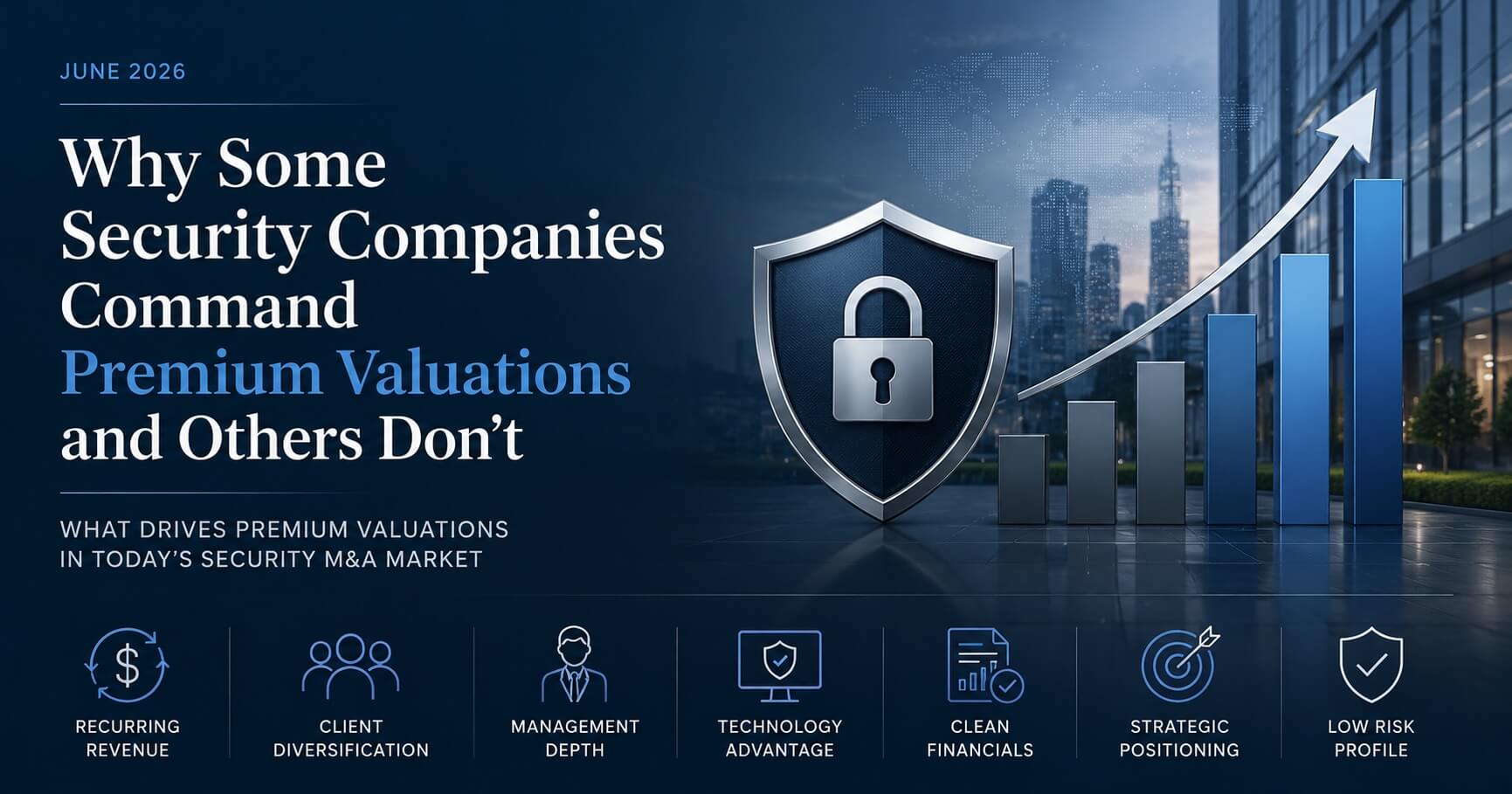
The market is no longer simply rewarding security companies for being large. The most sought-after businesses share a different set of qualities: Predictable Revenue / Client Diversification / Management Depth / Tech Differentiation / Clean Financials / Strategic Positioning / Low Risk Profile.
“Valuation is built over time, not at the point of sale.”
For owners thinking about an eventual exit, the key insight is this: the companies that invest in structure, leadership, and operational capability today are the ones that will command premium valuations tomorrow.
The window to build that value is now, not when a buyer calls.