
May 2026
The Privatization of Airport Security: What It Means for Operators and Investors
The debate over private-sector involvement in airport screening has moved from the fringes of policy discussion to the center of it. For security companies and M&A participants, the implications are significant and the window to position early is now.
Since the post-9/11 federalization of airport screening, U.S. airport security has been largely government-managed. But that model is under increasing pressure. Rising passenger volumes, persistent staffing challenges, and growing demand for operational efficiency have renewed serious interest in expanding private-sector participation and the security industry is paying attention.
For security guard companies and the investors and acquirers who follow this space, this isn’t just a policy story. It’s a potential market structure event, one that could reshape contracting opportunities, competitive dynamics, and M&A activity in meaningful ways.
Why the timing matters
This conversation has surfaced before, but today’s environment is different. Limited private operator programs have already demonstrated that an alternative model can work within federal oversight frameworks. Policymakers are increasingly open to scaling what’s been proven, particularly as the pressure on public-sector workforce pipelines shows no signs of easing.
The result is a rare moment: a large, institutionally controlled market segment may be opening — and the companies that understand the requirements and begin positioning now will have a meaningful first-mover advantage.
What this means for security operators
Entry into a categorically higher-volume market
Airport security is not traditional guarding work. It demands advanced training protocols, rigorous compliance standards, and the operational capacity to perform consistently under public and regulatory scrutiny. The contracts that come with it reflect that complexity. They tend to be large, long-term, and anchored to stable government or quasi-governmental relationships.
For firms capable of meeting the bar, this represents access to a volume of recurring revenue that is fundamentally more impactful than most of what the commercial security market offers.
Higher barriers mean less competition for those who qualify
This is not a space where low-cost labor models will compete. Meaningful investment in training infrastructure, compliance systems, and management depth is table stakes. That barrier is a feature, not a bug. It limits the field to operators with genuine sophistication and scale, which is exactly the kind of market position that commands premium valuations.
Execution and reputation become decisive differentiators
Airport operations are highly visible. Every failure, operational, reputational or compliance-related, is subject to intense public and regulatory scrutiny. That reality elevates firms with a proven track record of disciplined operations and a clean compliance history from competitors to preferred partners. In a market like this, reputation isn’t a soft asset. It’s a hard competitive advantage.
The M&A implications
If privatization gains meaningful traction, the downstream effects on deal activity could be substantial. Three dynamics are worth watching closely: Platform Expansion, Capability-driven Deals and Accelerated Consolidation.
Taken together, these dynamics would reinforce and accelerate the consolidation trend already underway in security services, but with a new, higher-value destination at the end.
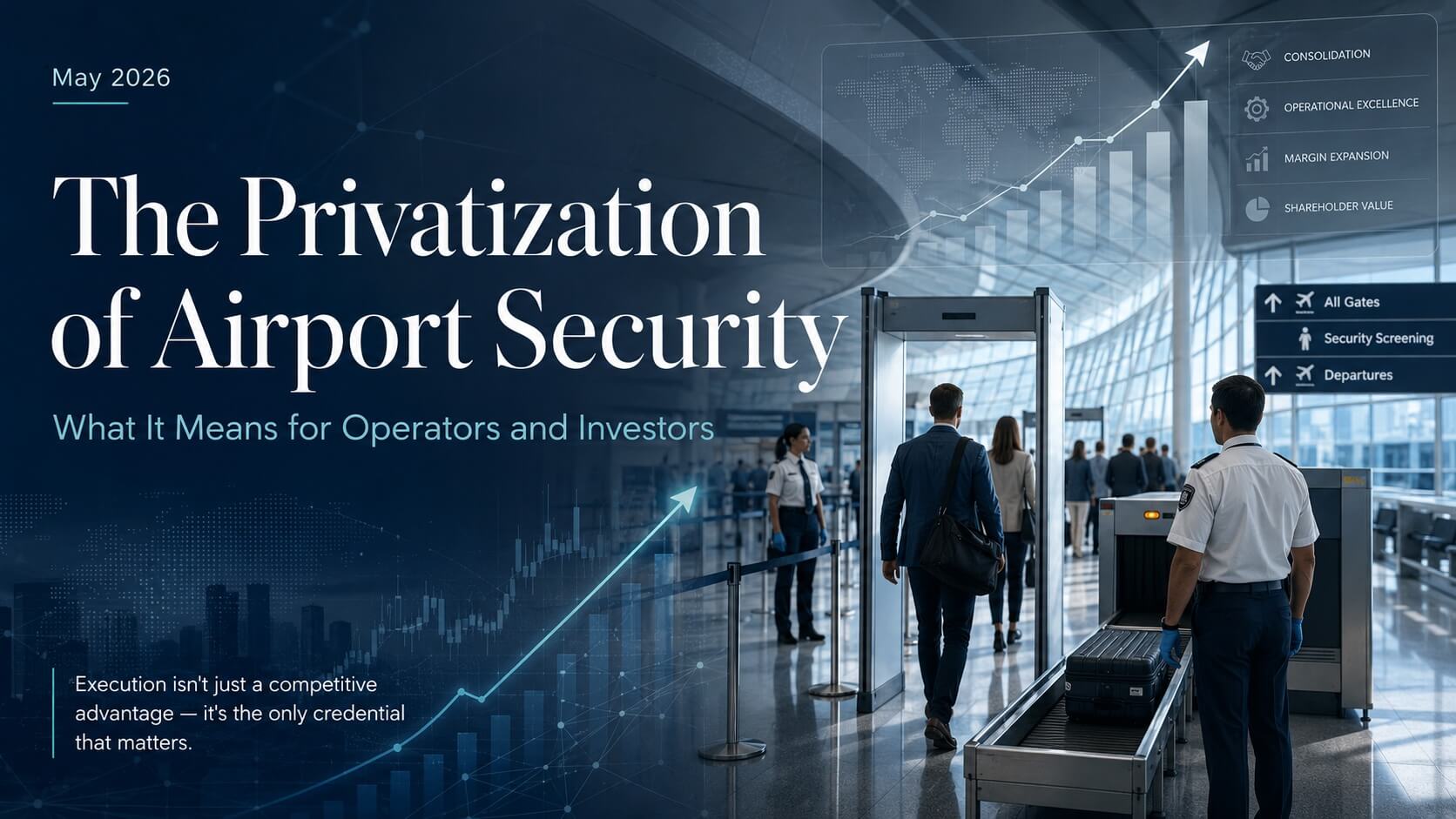
“In environments where the margin for error is effectively zero, execution isn’t just a
competitive advantage — it’s the only credential that matters.”.
The potential expansion of private-sector involvement in airport security is a meaningful inflection point for operators seeking to enter more sophisticated, defensible market segments and for investors and acquirers evaluating which companies are truly built for the next phase of industry evolution.
The companies that will benefit most aren’t those that react when contracts are announced. They’re the ones who have spent the intervening time building the infrastructure, compliance systems, and track record that make them the obvious choice when the door opens.